
STEP 01
Pin an element
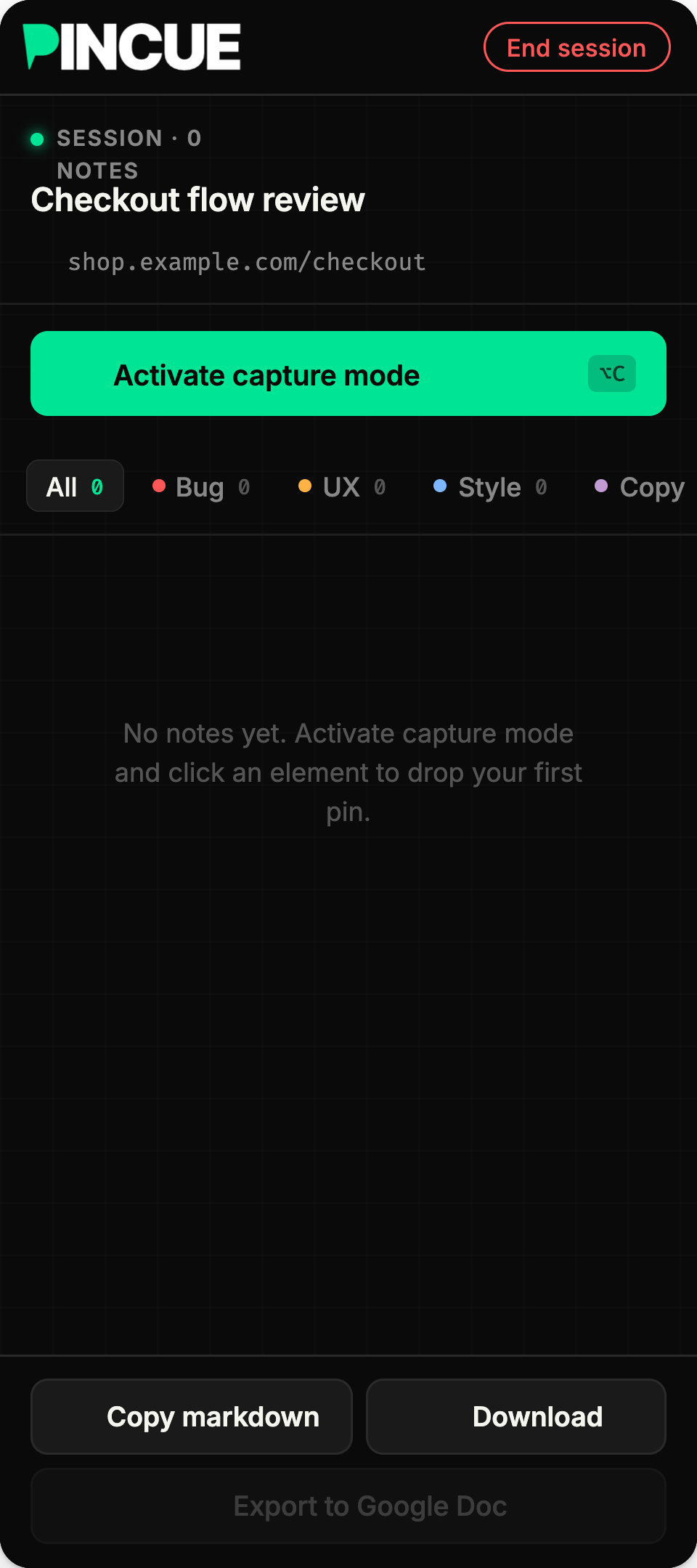
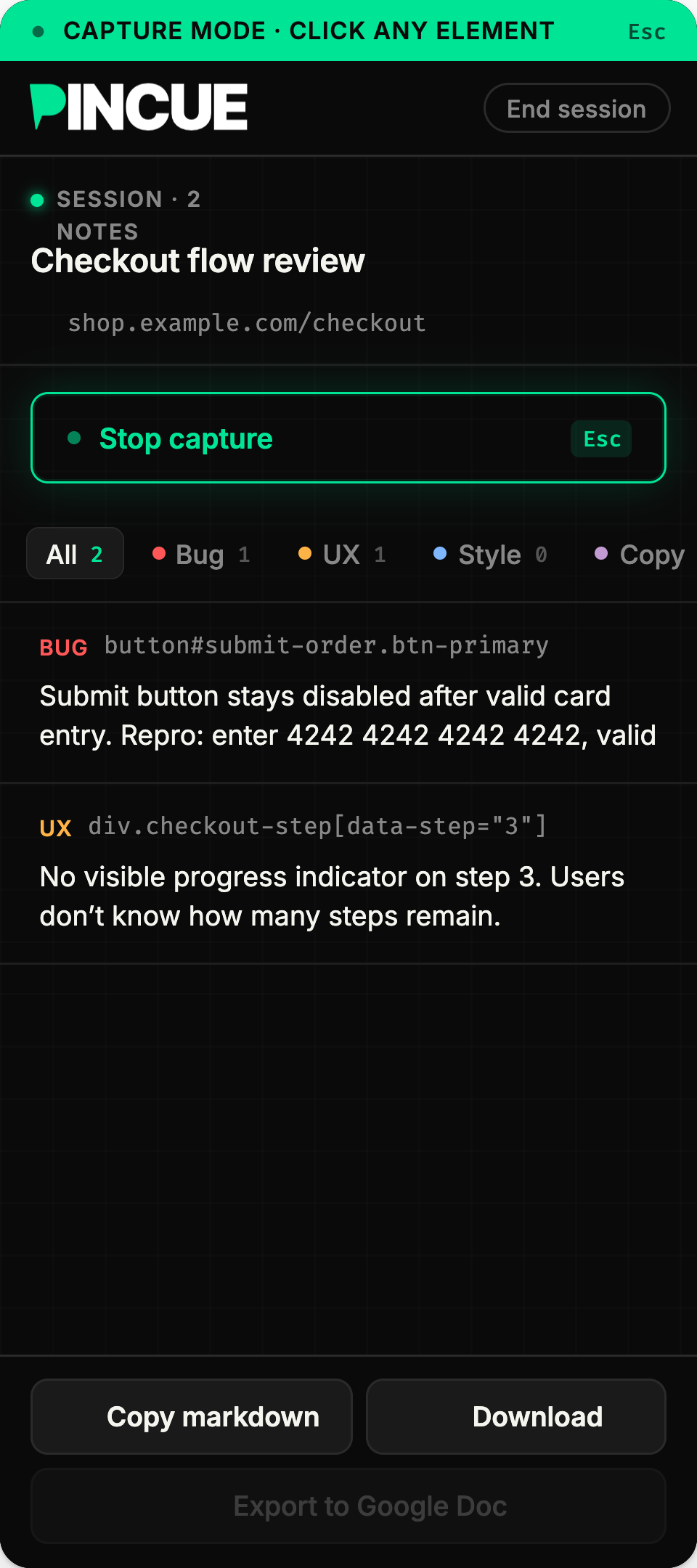
Open the side panel. Activate capture mode. Click anything on the page — Pincue locks onto the DOM node.
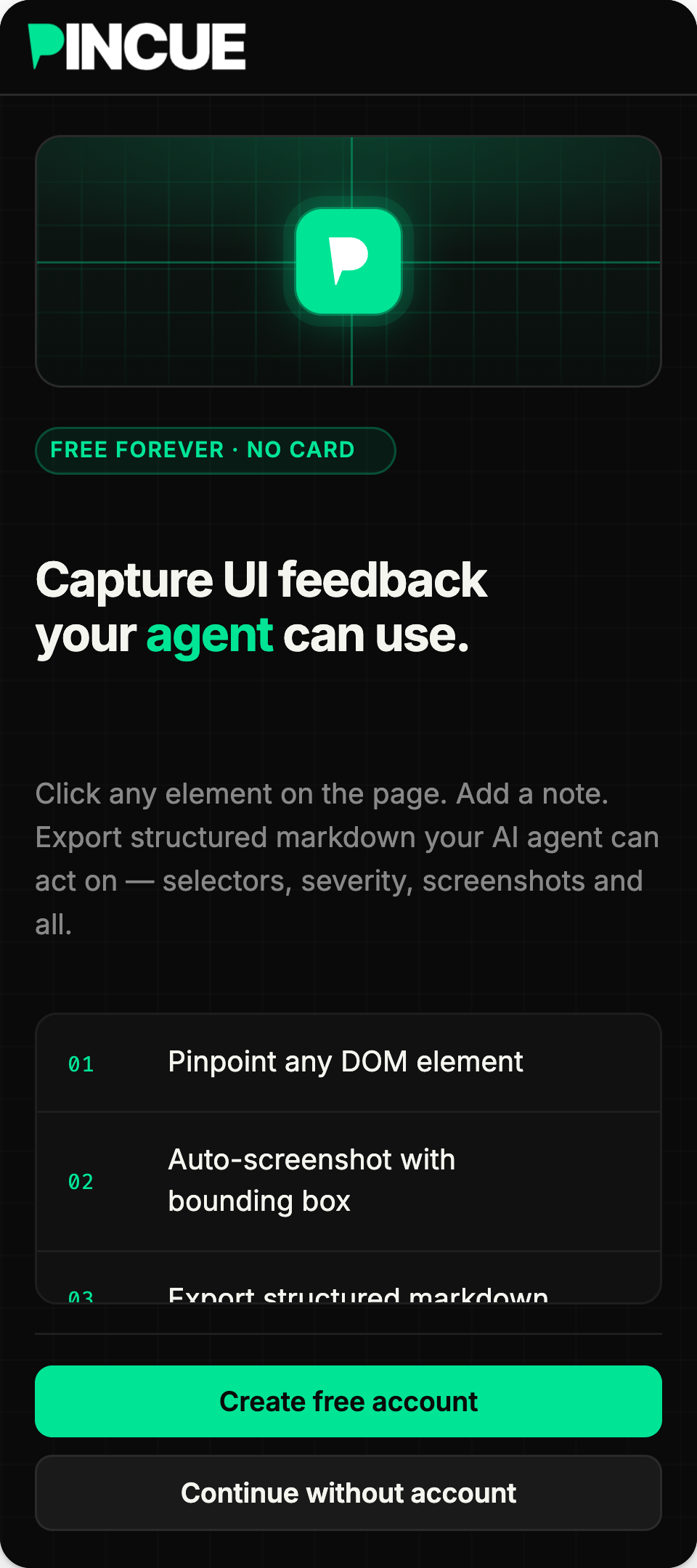
Superpowered feedback tool for AI builders.
A Chrome extension. Click any element & Pincue captures the selector & screenshot. Export one markdown file your agent acts on in one pass. No scripts. No tickets. No setup.
Four tiny steps. The whole loop takes less time than writing one of those "the button is broken, idk which one" feedback messages.
Open the side panel. Activate capture mode. Click anything on the page — Pincue locks onto the DOM node.
Pincue snaps the viewport with a green bounding box around your element. Zero ambiguity for whoever — or whatever — is reading.
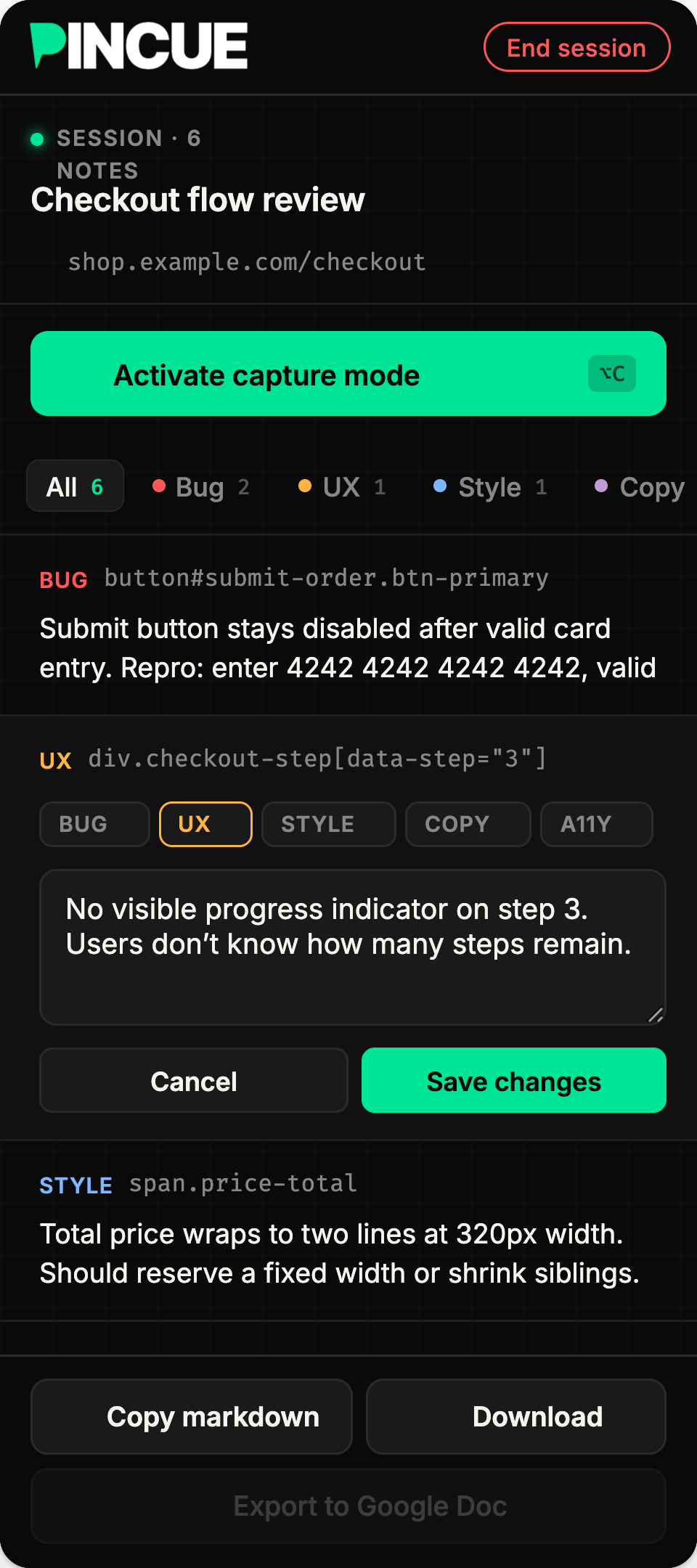
Tag it bug, UX, style, copy or a11y. Add severity. Drop the suggested fix. Edit inline any time.
Download feedback.md or copy markdown. Drop it in Cursor, Claude Code, anywhere.
Each pin captures the exact element — selector, screenshot, severity and your note — and packages it into a markdown block your agent acts on in one pass.
Submit button stays disabled after valid card entry. Repro: enter valid card details — button never enables.
Move setSubmittable(true) into the success branch of validateCard().
No step indicator on step 3 — users have no idea how many steps remain. Drop-off likely here.
Add "Step 3 of 4" label above the heading, matching the pattern used in step 1 and 2.
Price total wraps at 320px viewport — "€1,249." on one line, "99" on the next. Breaks on mobile.
Add white-space: nowrap to .price-total and ensure the parent has overflow handling.
Every guess your agent makes costs tokens. Pincue eliminates the guesswork — anchoring every note to the exact element, with context your agent can act on in one pass.
No element reference. No screenshot. Your agent guesses, edits the wrong file, breaks the test. You re-explain. You burn €0.42 of tokens. You re-explain again.
Smart selector. Screenshot. Severity. Suggested fix. One export. Your agent reads it once and acts — no follow-up, no guesswork, no wasted credits. No Jira ticket. No team dashboard. Just the fix.
Every note is pinned to the exact DOM element — id, classes, role, full CSS path. Zero ambiguity.
Structured feedback means your agent acts on the first read. No re-prompting, no token burn from vague back-and-forth.
Review an entire flow — checkout, onboarding, whatever — in a single session. Export once. Your agent handles the full batch without you re-explaining anything.
Screenshots with bounding boxes remove interpretation. What you saw is what the agent sees.
Capture feedback on your Testing, Staging & Production environments right inside your browser.
Every note exports as a clean markdown block — element, selector, role, severity, your feedback, suggested fix, and screenshot path. Nothing to restate. Nothing to translate.
Viewport snap with a green bounding box. No crop, no edit, no ambiguity.
Shortest unambiguous CSS path. ID-first, never fragile nth-child chains.
Color-coded so your agent knows what to prioritize.
⌥ C to capture, Esc to stop, ⌘ Enter to save. Zero mouse if you want.
One section per note. Element, severity, fix, screenshot path — formatted for AI agents.
No more Loom videos. Click the element, add your note, export a file the developer or their agent acts on directly.
Your own PM, QA, and designer. Pincue is the review pass before every deploy — structured and ready for your agent.
You don't file tickets — you drop a markdown file into Cursor, Windsurf, or Claude Code and ship. Pincue produces that file.
Guest review links, real-time note feed, triage before export. Client never needs an account.
The difference isn't features. It's intent.
Jam captures what broke. Pincue captures what you want changed. Those are different jobs. Pincue is built for one of them.
The core tool is free forever. Pro — with session history, team sharing and more — is coming soon.
Everything you need to capture and export feedback.
No account required to get started.
The full feedback loop — for developers and designers who work with clients.
No. Pincue works fully without one — your notes are saved in local browser storage and persist until you clear it or start a new session. Create a free account to keep your session while the panel is open across tabs. Pro with full cloud sync and session history is coming soon.
Any agent that reads markdown. We test against Cursor, Claude Code, Windsurf, GitHub Copilot, and Aider — but the output is plain text, so it slots into anything.
Chrome, Edge, Brave, Arc — anything Chromium. Manifest V3. Firefox support is on the roadmap.
On Free, in-memory only — they go with the session. On Pro, encrypted in your account. Never used to train anything, ever.
Yes — Pincue runs locally in your browser. If you can see it, you can pin it.
Pro includes shared workspaces for up to 5 teammates. Larger teams — drop us a line.
Jam and Marker.io are built to capture bugs and push them into team workflows — Jira, Linear, Slack. They're reactive tools designed for teams. Pincue is built for deliberate review sessions and exports a markdown file structured specifically for AI coding agents. No team required. No PM tool needed. No script on your site. You review, you export, your agent fixes. That's the whole loop.
Install in 30 seconds. No account. No signup. Pin your first note in under a minute.